

My last post ended (rather suddenly; I was in a rush) with a 1956 film for the Sheffield City Council Libraries Committee entitled "Books in Hand". It's a film to which I regularly find myself returning, as a reminder of how library services aspired to be in the post-war decades, and how much our own aspirations coincide with those of half a century ago. There's emphasis in the film of looking bright and new rather than fusty and drab ("Here's a dreary lot in a library of yesterday... What a contrast with this typical bookcase in the libraries today"; "The old, restrictive, dull junior sections have gone; Today the policy is freedom of choice in an atmosphere of beauty"), and while the stress is on books, there's a determined effort to convey the full range of library services: reference enquiries, civic information, local history, filmshows, gramaphone recitals, theatre performances, and engagement with children (including information literacy outreach, storytelling, study classes and social activities) and the elderly.
It's useful to be reminded that our service and our aspirations are consistent with those of the past, and that our attempts at reinvention or innovation may not be as novel as we may sometimes assume. Perhaps there is also stuff which we were doing back then, which we may have stopped doing, for one reason or another, and which we would like to do again. In such cases, the past may have some crucial advice for us to take on board. It's a theme which, quite by chance (or by something in the water), @LibWig recently addressed in an effective manner in this 'blog post. And it's a theme which I shall continue to puddle here.
In academia we are generally taught to concentrate our research on recent history; perhaps the last ten years or so. Newer is better: currency is valuable currency when ascertaining relevance (that older items are less likely to be online helps a little, too). There's good sense in this approach, of course: it thins out our reading, and one might hope that any key knowledge of the past survives through chains of citations to the relevant present. But this is not always the case. There are gaps in our history: occasionally theories and ideas skip a generation and in such cases the wisdom of the past does not reach through to us. Two thirds of a century ago, a new technology allowed us to reproduce texts and documents in a tiny data format that could be stored on a small card or cartridge and brought up on a screen for reading. Millions of texts were copied into this format, allowing disposal of bulky originals in certain circumstances. The technology of microforming may be different to the technology of today's digitization projects, but some useful advice may lie buried in a journal article somewhere, perhaps on microfiche and therefore lying unread.
Or perhaps not. But surely it's worth a look (if you can find a microform reader to read it on).

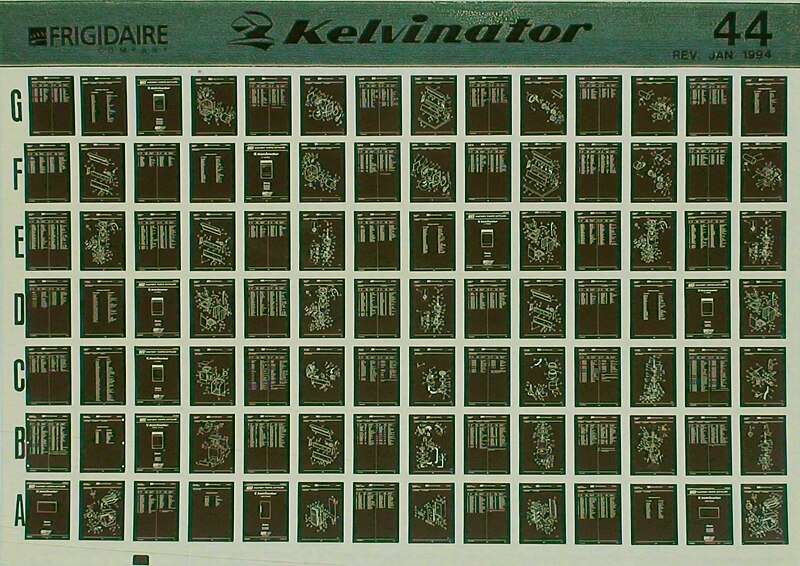
Je m'en fiche...
The analogy of microform to digital extends beyond digitization. There was a real microform fever: at one extreme, microform catalogues, which I can only assume must have been a right pain in the bum; at the other end, photocharging: one of many attempts to replace Browne with something a little more hi-tech, in this case by taking a photograph of the book and the borrower's card when an item was checked out. Technology for technology's sake, to an extent, but it apparently sped things up whilever the machinery worked.
In the mid-1970s, as computers began to arrive in our libraries, a host of new technologies emerged, not least in bookcharging. The barcode systems of Plessey and their innovating competitors Telepen have become commonplace. In 1977 Telepen replaced Bookamatic (a system using carbon paper and embossed plastic cards for books and patrons, that emulated the paperwork methods employed in credit card transactions of the day) as the charging system at the institution where I currently work. Perhaps the most futuristic charging technology, though, was the ALS label system. Perhaps it sounds familiar:
"book numbers are coded in the form of labels which are fixed inside the book... When an issue is made, the information encoded in the labels is read electronically rather than mechanically... the book label sensor (which is built into the counter) is capable of reading the label as the unopened book is passed over the counter top."
I'm pretty sure we had ALS in Rotherham in the '80s, and those of you at the right side of Emerald's paywall can find a good description of it courtesy of the University of Strathclyde (1978). It worked along the same lines as RADAR, picking up the reflected signal of an encoded array of ≈1cm diameter aluminium dots within the label. While it therefore fell somewhat short of RFID in that the book had to be correctly placed over the scanner and only one book could be read at a time, there are clear similarities between the technologies. But in those days before self service, it was still necessary to open the book in order to stamp it with the due-date, and so it was that the black magic was wasted upon us.
On the subject of RFID, it's perhaps worth mentioning that the RF part of that technology has been a feature of libraries since the '80s (the shelves around me right now are stuffed with foxing labels containing the familiar square circuit of an RF antenna) as a security detection device. These tags are now largely obsolete; magnetic strips are a simpler technology and one more suited to self-issue (they lend themselves more readily to the desensitization and resensitization demanded of library stock control). Much of the deployment of RFID has neglected to acknowledge the similarities with past systems, and this can trigger cynicism in older employees who may think they've seen it all before. In many cases they have, and all too often we ignore them.


All books in the library are fitted with RF antennae
so that they may enjoy listening to Radio 4 LW.
so that they may enjoy listening to Radio 4 LW.
RFID is new and exciting (although where I work it is employed in such a limited way that we may as well be using ALS) in the way that tags can be read (allowing 'intelligent shelving') and the way in which database cross-referencing determines security status (potentially permitting automatic bookcharging as we pass through the door). But not everything under the sun is as new as we might be led to think. Technology is, by and large, the safer bet with regards to novelty. Theory is often far less progressive. It is not unknown for a library manager to come into a library and implement a cutting-edge new form of counter service or an exciting new loan policy that is actually identical to a policy that was in place twenty or thirty years ago. The older library assistants shrug and tut. They've seen it all before.
Why did we stop doing six-hour loans? Why did we feel the need to reintroduce fines when in 1977 lending restrictions for patrons with overdue books were sufficient penalty? Before we abandon fines or reintroduce short-loan categories (I'm plucking these examples ad hoc and on the hop you understand), perhaps we need to look back and ascertain why and how we got where we are. The past may be a foreign country, but so are foreign countries, and we've learnt an awful lot from them over the years.
Circumstances change, of course; what failed thirty years ago may prove quite effective today. But that doesn't mean we should disregard that which went before. What works in the US may not be applicable to the UK but it doesn't stop us reading about it and considering the possibilities. A bit of wider, deeper research can only add to our plans or debates, and in the case of history it provides us with a reasonable context for where we are now. As was at the core of @LibWig's post, it's important for new staff to engage with their more seasoned colleagues. Not only do the newbies learn from the experience of the oldies, but the oldies feel included in and less jaded by the newbies' discussions and proposals, and the newbies avoid becoming just another load of fresh graduates walking into the mistakes of yesterday. As someone once wrote: "Those who cannot remember the past are condemned to repeat it".


